In the last post, we did a deep dive into Agile and Lean project management, covering their origins, history, and practical applications. At the end of the day, every principle, board, and rule shares the same goal: superior project management. But you cannot effectively manage what you do not understand. That is why today’s post focuses on Kanban and Scrum.
Many teams around the globe are drowning in tickets and watching their Sprints crash; consequently, they are turning to an ‘Agile transformation.‘
In short, both Scrum and Kanban are tools that are designed to solve specific problems regarding how human beings organize complex work. To understand which one fits your needs, we have to strip away the marketing fluff and look at the mechanics of how they function, where they break, and why they exist in the first place. In the end, all of us want to deliver value to customers without burning out the people doing the work.
Agile is not a methodology; it is a philosophy. That means you cannot “do” Agile. You can only “do” a framework that embodies Agile principles. This is where Scrum and Kanban enter the picture. They are the tactical execution of the Agile strategy.
What are Scrum and Kanban then? In the simplest terms, Scrum is about structured iteration. It provides a rigid skeleton of roles and events to force predictability in an unpredictable world. Kanban, on the other hand, is about continuous flow. It provides a visual management system to optimize the speed and efficiency of value delivery without necessarily changing the underlying process immediately.

What is Scrum? How Did it Become What It Is?
In the early 90s, Jeff Sutherland and Ken Schwaber came up with a new and better way to build software: Scrum. The rationale behind Scrum was simple: You cannot plan perfectly because software development is complex and, more importantly, unpredictable. In the process, requirements change hourly and stakeholders always want “one more feature.” To handle this, Scrum draws a line in the sand called the Sprint
Sprints typically last 1 to 4 weeks. Aligned with Parkinson’s Law, which states that “work expands to fill the time available for its completion.” By artificially constraining the time available, Scrum forces the team to focus, prioritize ruthlessly, and make difficult trade-off decisions early. The Sprint also serves to limit the cost of failure. The cost of a mistake in Scrum is the length of one Sprint.
Advantages and Disadvantages of Scrum
Pros
- High Visibility: Stakeholders see progress every two weeks.
- Clear Accountability: The team commits to a goal.
- Problem Resolution: The Daily Scrum ensures blockers are highlighted immediately.
- Sustainable Pace: Theoretically protects teams from burnout by limiting scope to capacity.
- Team Cohesion: Fosters a strong sense of shared ownership and identity.
Cons
- Rigidity: Mid-sprint scope changes that threaten the Sprint Goal are discouraged.
- Meeting Fatigue: For developers who just want to code, the overhead of Planning, Review, Retro, and Daily Scrums can feel excessive.
- “Water-Scrum-Fall”: Many organizations adopt the terms but not the culture, resulting in mini-waterfalls inside two-week cycles.
- Estimation Paralysis: Teams often spend hours arguing over whether a task is a “3” or a “5” in Story Points, which can be a waste of time.
- Scope Creep (via Backlog): Without a strong PO, the backlog becomes a junk drawer of endless ideas.
- Enterprise-Level: Scaling at the enterprise level is hard; methodologies like SAFe come into play.
- Long-Term Estimates: For some teams, making long-term time estimates is difficult.
What is Kanban?
The Origins: From Supermarkets to Software
“Kanban” is Japanese for “visual signal” or “signboard”, and its first use wasn’t in software development. It started on the factory floor of Toyota.
Kanban is less of a rigid framework and more of a management method. It doesn’t tell you how to develop software (it doesn’t prescribe roles like Scrum); it helps you visualize how you are working today so you can optimize it tomorrow.
The Core Principles of Kanban
While Scrum prescribes a specific structure, Kanban is defined by a set of principles and practices focused on flow. It treats the software development process as a pipeline. The goal is to maximize the throughput of value through that pipeline.
Boards
You cannot manage what you cannot see. In manufacturing, you can see the pile of steering wheels waiting to be installed. In knowledge work, the “inventory” is invisible. It’s code inside a repository, ideas inside a designer’s head, or tickets in a database. Kanban forces this work onto a board, physical or digital board.
A basic board has “To Do,” “Doing,” and “Done.” But a real Kanban board reflects the actual complexity of the process: “Backlog,” “Analysis,” “Dev,” “Code Review,” “Testing,” “Deployment,” “Done.”
Limit Work in Progress
Limiting Work in Progress (WIP) is the most powerful aspect of Kanban. Most teams believe that to get more done, they need to start more work. Kanban argues the opposite: Stop starting, start finishing.
By placing a hard limit on the number of cards allowed in a specific column (e.g., “Max 3 items in Testing”), you force the team to focus.
Manage Flow
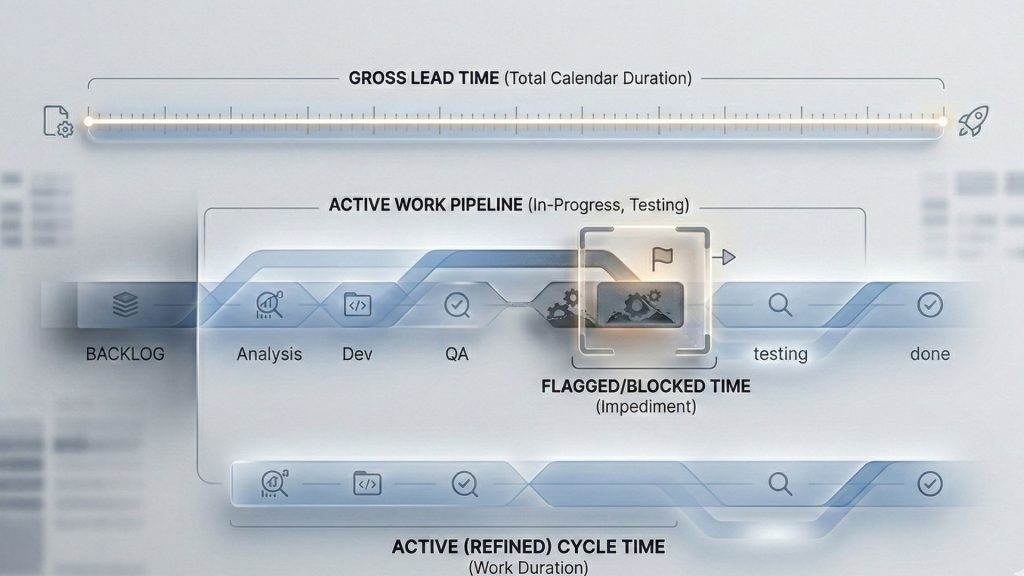
The goal of Kanban is to move cards from left to right as smoothly and quickly as possible. We measure this using metrics like Lead Time (time from request to delivery) and Cycle Time (time from starting work to delivery). The focus is not on “how busy is the team?” (resource utilization) but on “how fast is value moving?” (flow efficiency).
Make Policies Explicit
In Scrum, the rules are in the Scrum Guide. In Kanban, the team writes their own rules and posts them on the board. So, teams can answer questions like ‘’Who is allowed to pull from the backlog?” or ‘’When is it okay to move a ticket back?”
Implement Feedback Loops
Kanban does not mandate specific meetings like Scrum, but it requires feedback loops. These are often called “Cadences.” These are scheduled based on need, not a rigid calendar.

Advantages and Disadvantages of Kanban
Pros
- Extreme Flexibility: You can change priorities instantly. If a critical bug comes in, it goes to the top of the queue.
- Reduced Overhead: No Sprint Planning or massive Retrospectives required. Less time in meetings means more time working.
- Continuous Delivery: Work is released as soon as it is done. Ideal for CI/CD environments.
- Focus on Flow: WIP limits actively fight burnout and context switching.
- Real-World Modeling: It models the actual arrival of work better for Support/Ops teams.
Cons
- Lack of Urgency: Without the “Sprint Goal” and a hard deadline every two weeks, work can sometimes drift. Parkinson’s Law can work against you here.
- Requires Discipline: Scrum’s rules are a safety net for immature teams. Kanban’s “do what works” approach can lead to chaos if the team doesn’t respect WIP limits.
- Scope Creep: Because you can add items to the backlog at any time, the project scope can balloon if not managed carefully.
- Single Points of Failure: Specialized roles (silos) can persist if the team doesn’t actively cross-train.
- Harder to Forecast: Predicting exactly what will be done by a specific date 3 months from now can be harder without the “bucket” logic of Sprints.
Kanban vs Scrum: What are Main Differences?
Now that we have established the baselines, let’s look at the direct comparison of Kanban and Scrum.
Cadence
Scrum is fixed length Sprints, usually 1-4 weeks. Kanban is continuous flow.
Release Methodology
For Scrum, typically at the end of a Sprint. For Kanban, whenever an item is ready.
Roles
Scrum is prescriptive, requires positions like PO, Scrum Master, and Developers. But Kanban does not prescribe roles.
Key Metric
Scrum, velocity, especially Story Points per Sprint. For Kanban, it is Cycle Time and Lead Time.
Change Philosophy
Scrum discourages scope change to protect the Sprint Goal. Kanban welcomes change as long as capacity exists.
Visual Management: Scrum Board vs Kanban Board
If you are using Jira (and let’s be honest, who isn’t), the distinction between Scrum and Kanban manifests most visibly in the Board. This is where the abstract concepts become real on a screen.
Scrum Board: The Sprint Container
A Scrum Board in Jira is a temporary artifact. It relies on the “Sprint” entity.
The Scope: It shows only the work committed to the current active Sprint. The vast backlog is hidden in a separate view/tab.
The Goal: The goal is to clear the board. An empty board at the end of the Sprint is a victory.
The Workflow: Typically “To Do,” “In Progress,” “Done.” While you can add more, the focus is usually on status relative to the Sprint end date.
Reporting: It drives the Burndown Chart (work remaining vs. time) and Velocity Chart (points completed per sprint). These are “batch” metrics.
Kanban Board: The Infinite River
A Kanban Board is persistent. It is a river that never dries up.
- The Scope: It shows the flow of work from the backlog to completion, forever. It uses a Kanban Backlog (if enabled) or just the left-most column.
- The Goal: The goal is not to clear the board, but to keep cards moving. A cleared board in Kanban means the team has run out of work (which is bad—starvation).
- The Workflow: These columns represent the process steps. In Kanban, “In Progress” is not a bucket; it is a journey (Analysis -> Dev -> Review -> QA).
- WIP Limits (The Killer Feature): In Jira, you can set “Min/Max” constraints on columns. If the “Dev” column has a max of 3, and you drag a 4th card in, the column turns red. This visual alarm is unique to Kanban in Jira and is essential for the methodology.
What is Scrumban?
For many teams, the choice between Scrum and Kanban is a dilemma. Why choose between structure and flow when you can have both? Enter Scrumban.
Scrumban is not just “Scrum with a Kanban board.” It is a deliberate methodology that originated as a way to transition teams from Scrum to Kanban, but evolved into a standalone framework.
Scrumban takes the structure of Scrum (roles, meetings) and applies the flow principles of Kanban (WIP limits, visualization, pull system). It is the sweet spot for teams that need the “heartbeat” of Scrum but the flexibility of Kanban.
What are the Key Aspects of Scrumban?
- Keep the Sprints: Many Scrumban teams keep the two-week cadence for planning and retrospectives. This keeps the organization happy with a predictable rhythm.
- Shift the Commitment: Instead of “committing” to a fixed batch of 30 points, the team creates a “Sprint Goal” but pulls work continuously. If the Sprint ends and a task isn’t done, it’s not a failure; it just continues.
- Add WIP Limits: This is the game-changer. By applying WIP limits to a Scrum process, you prevent “Sprint stuffing” where teams take on too much work on Day 1. You force flow within the Sprint.
- On-Demand Planning: Instead of a massive planning meeting every two weeks, planning happens when the “Ready” column falls below a certain threshold. This reduces meeting time.
In the end, whether you call it Scrum, Kanban, or “Agile-ish,” the goal is the same: deliver value to customers faster and with higher quality. Don’t get hung up on the purity of the framework. Try, analyze and always push for a better process.